
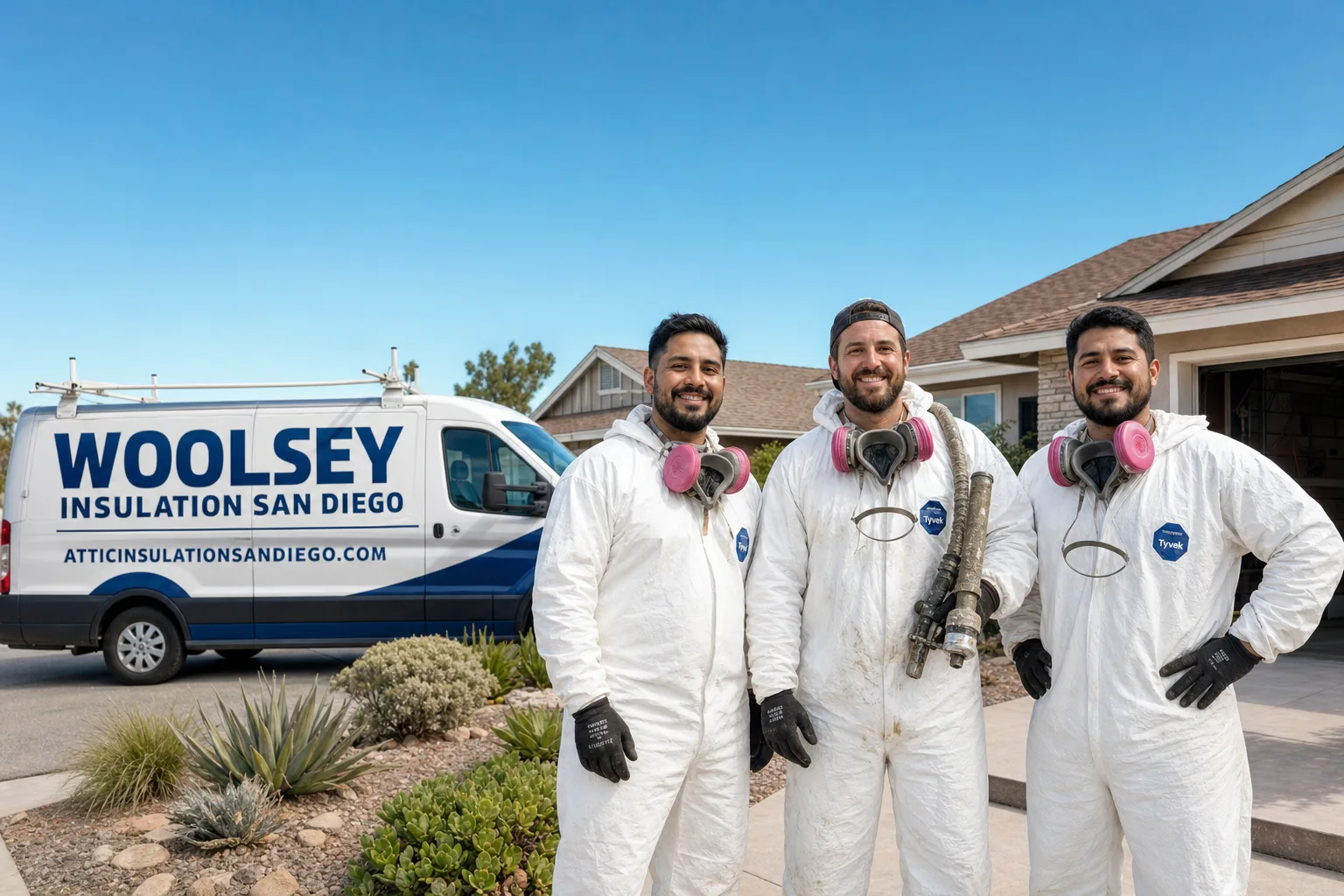
Fast, Reliable Spray Foam Insulation Across San Diego
Spray foam insulation in San Diego typically runs between $3,200 and $7,800 for a full attic application, and most jobs are completed in a single day. If you’re calling about a specific room, rim joists, or a garage ceiling, you’re looking at a tighter range of $900 to $3,100. Woolsey Insulation San Diego, led by Glenn Hartley, handles open-cell and closed-cell spray foam work throughout San Diego, from Coronado to Rancho Bernardo. We answer the phone live, 24/7, and we give you a written price before any work starts. Call (619) 344-8538 for a free estimate.
Why Woolsey Insulation San Diego Is San Diego’s Preferred Spray Foam Insulation Company
We’re not a national chain or a franchise. Woolsey Insulation San Diego is independently owned and operated under the Kingswell banner, and we’ve been doing attic and Spray Foam Insulation work in San Diego since Glenn Hartley took the helm. Our local reputation rests on one thing: we do what we say we’ll do, and we put it in writing. Every job comes with the 365-Day Done Right Promise. If the installation isn’t right within a year, we come back and fix it at no charge. That’s not a slogan. It’s in the paperwork every homeowner receives before we start.
San Diego homeowners call us because they’ve been burned before by contractors who changed the price at the door or never showed up in the promised window. We commit to a real arrival window, and we hit it. Our technicians are background-checked and uniformed, so you know exactly who’s walking into your home. The Kingswell Guarantee covers a written price before work starts, a committed arrival window, a clean job site, a written guarantee on the work, and a free return visit if a repair fails within the guarantee period. We don’t ask you to take that on faith. You get it on paper.
Open Cell Spray Foam in San Diego
Open Cell Spray Foam is the workhorse insulation for San Diego attics, especially in post-war single-family homes where the original fiberglass batts have settled to half their intended R-value. It’s a two-part liquid that expands on contact, filling gaps and sealing air leaks that batts simply can’t reach. In San Diego’s inland valleys like Clairemont and Allied Gardens, where daily temperature swings run 20 to 30 degrees between noon and midnight, air-sealing matters every bit as much as R-value. Most full-attic open-cell jobs in San Diego run between $3,200 and $5,900, depending on square footage and how much old material we need to remove first.
Air Sealing the Attic Floor
The real performance gain from open-cell foam comes from sealing the top plates, wiring penetrations, and recessed light gaps where conditioned air leaks into the attic. In a 1960s Clairemont home, we often find a dozen or more untreated bypasses around can lights and partition walls. Sealing those before the foam goes in is what makes the difference between a marginal improvement and a 20% drop in your SDG&E bill.
R-21 Retrofit in Five Inches
Five inches of Icynene open-cell foam delivers R-21 and a continuous air barrier in one pass. We recently sprayed a 1960s single-story home in Clairemont where the original fiberglass had settled to barely R-11 in the attic. We removed the old batts, air-sealed the top plates, and applied five inches of open-cell foam. The homeowner reported a 22% drop in their July SDG&E bill and no more drafts around the recessed lights.
Spray Foam Insulation Contractors in San Diego
Spray Foam Insulation Contractors in San Diego need to understand this city’s specific housing stock. Post-World War II wood-frame homes with stucco cladding dominate neighborhoods from Clairemont to Allied Gardens, and many have unvented attics that were originally insulated with R-11 batts. Applying spray foam to those attics without proper ventilation design can trap moisture against the roof deck and cause the foam to delaminate. We check ventilation before we recommend foam on any San Diego roof deck. Closed-cell spray foam work in San Diego typically runs $4,500 to $7,800 for a full attic, while rim joist sealing runs $900 to $2,200.
What to Expect From Our Crews
Every technician who arrives at your San Diego home is background-checked and uniformed. We work with eight insulation brands, including Icynene, Demilec, and CertainTeed, so the material you get fits your home’s needs, not whatever’s on the truck. And because we’re a local San Diego operation, we stock the foam, rigs, and safety gear for this climate: coastal humidity, inland heat, and everything in between.
Closed-Cell for Rim Joists and Roof Decks
Rim joists in San Diego’s older homes leak air at every floor line, especially in two-story stucco houses where the band joist sits directly on the foundation. Closed-cell foam at R-7 per inch seals and insulates that junction in one step. For cathedral ceilings and spray foam roof decks, closed-cell is also the right call because its vapor permeability is far lower than open-cell, which matters when marine-layer moisture tries to push through from outside.
Trusted Brands We Service in San Diego
We install and service spray foam from Icynene, Demilec, and CertainTeed, along with five other leading brands. San Diego homeowners get an honest material recommendation based on their home’s construction and microclimate, not a one-brand pitch. Because we’re local, we keep the needed components and foam formulations on hand for fast turnaround on service calls across San Diego. If a previous foam job is failing, we can usually diagnose and fix it within the week.
Common Spray Foam Insulation Problems We See in San Diego Homes
- Coastal corrosion in Ocean Beach and Point Loma. Salt-laden air accelerates corrosion of stucco wire mesh, which creates hidden voids behind the lath. Spray foam injected into those walls escapes through the gaps, leaving cold spots and wasted material. We check wall cavities with a borescope before quoting coastal retrofit work.
- Unrated recessed lights in Clairemont and Allied Gardens. Original can lights from the 1960s and 1970s often lack IC-rated housings. Foam can’t be applied directly against those fixtures without creating a fire hazard, and leaving gaps around them means thermal bypasses. We identify every non-IC fixture and either replace the housing or isolate the ceiling penetration before foaming.
- Unvented attics with roof-deck foam and no design plan. Post-war San Diego homes frequently have unvented attics. When closed-cell foam is applied directly to the roof deck without accounting for moisture drive, condensation can build up at the deck and cause the foam to delaminate. This is a San Diego-specific failure mode tied to our marine layer and cool winter nights.
- Compacted fiberglass under old foam retrofits. Some San Diego homes had partial spray foam work done years ago, then later had fiberglass blown over it. The fiberglass compacts, the foam loses its air seal, and the whole system stops performing. We see this regularly in North Park and Normal Heights remodels from the early 2000s. The fix usually means removing everything and starting with a clean substrate.
Pricing for Spray Foam Insulation in San Diego, CA
Here’s what you can expect to pay for spray foam work in San Diego right now. A full open-cell attic in a 1,200-square-foot single-family home runs $3,200 to $5,200. The same attic with closed-cell foam runs $5,100 to $7,000. Rim joist sealing in a typical two-story San Diego home runs $900 to $1,900. Garage ceiling spray foam runs $1,200 to $2,600 depending on whether the garage is attached and whether we need to remove existing drywall. These are real ranges based on local jobs we’ve quoted. We give you the exact written number before any work starts, and that number doesn’t change at the door.
We Also Serve Cities Near San Diego
Our crews handle Spray Foam Insulation in San Diego and the surrounding communities. We regularly work in Coronado, National City, Lemon Grove, and Bonita. If you’re in any of those areas and need spray foam, rim joist work, or an honest assessment of your existing insulation, call us and we’ll schedule a time that works for you.
Serving San Diego, CA - Our Local Coverage Area
We’re based in the San Diego area and know this community well. Use the map below to see our service coverage - if you’re nearby, we can almost certainly help.
FAQs About Spray Foam Insulation in San Diego
It absolutely makes sense for most San Diego homes, especially inland. Coastal areas like La Jolla stay moderate year-round, but inland valleys like Clairemont, Allied Gardens, and Mission Valley see 30-degree daily temperature swings and summer attic temperatures above 130°F. Air-sealing matters more than R-value in San Diego, because humidity and salt air move through even tiny gaps. Spray foam addresses both simultaneously. For coastal condos with minimal wall cavities, open-cell may be a smarter, more cost-effective choice than closed-cell. Call (619) 344-8538 and we’ll help you figure out what your specific building actually needs.
Look in the attic. If the fiberglass batts are sitting below the top of the ceiling joists, or if you see dark streaks along the batts where dust has collected, your insulation is underperforming. Original R-19 batts from a 1960s Clairemont home are often compacted to R-8 or less after decades of moisture, dust, and gravity. Another tell: your upstairs hallway gets hot in the afternoon while the air conditioning is running. We’ll inspect it for free and show you exactly what we find before we ever quote a price.
Yes, with the right preparation. Older non-IC-rated can lights must never have foam applied directly against them, and a knowledgeable contractor will either replace those housings with IC-rated fixtures or build an isolation barrier around them before spraying. The gap-and-foam shortcut creates a real fire hazard. We inspect every ceiling penetration in your San Diego home before we touch the gun, and the written quote you receive includes any can-light corrections the job requires.
It can, but the placement matters more than the product. Open-cell foam sprayed on the attic floor provides meaningful acoustic dampening for overhead noise and helps reduce street noise that vibrates through the roof assembly. For walls facing the 805 corridor, dense-pack cellulose or closed-cell foam injected into the stud cavities cuts low-frequency road noise better than batts. We’ve done this work in Normal Heights and North Park homes within earshot of the freeway, and the interior difference is noticeable the same day.
Because moisture gets trapped between the foam and the wood sheathing. San Diego’s marine layer pushes humid air against the underside of roof decks during the night, and when the sun heats the roof surface the next morning, that moisture turns to vapor. If the roof assembly isn’t vented or the foam wasn’t applied at the correct temperature and thickness, the bond fails and the foam pulls away. This is a known failure mode in Ocean Beach and Point Loma. The fix is usually removing the delaminated foam, addressing the ventilation, and reapplying with a proper vapor management strategy. Call (619) 344-8538 for an inspection and a written remediation plan.
Written by Glenn Hartley, Owner at Woolsey Insulation San Diego.