
How Much Does Insulation Cost in San Diego?
Most San Diego homeowners pay between $1,700 and $4,800 for attic insulation, with the average job landing around $3,100. Spray foam runs higher, typically $3,200 to $7,500 depending on square footage and foam type. The exact number for your home comes down to attic size, existing insulation condition, and the material you choose, but you’ll get a written price from us before any work starts.
San Diego’s climate creates a specific insulation need set. Our coastal marine layer keeps mornings damp, inland valleys swing 30 degrees between day and night, and summer attic temperatures routinely hit 140°F. That means insulation here isn’t just about winter warmth, it’s about keeping conditioned air inside year-round and preventing moisture problems that plague homes from Point Loma to Rancho Bernardo.
Insulation Cost Breakdown (2026)
Here’s what we’re seeing across San Diego County in 2026. These ranges reflect actual jobs our crews have priced in neighborhoods like Clairemont, La Mesa, Chula Vista, and Escondido over the past 12 months.
| Insulation Type | Typical Cost Range (San Diego) | Best For |
|---|---|---|
| Blown-in fiberglass (attic) | $1,700 – $3,200 | Most existing homes, attics with irregular joist spacing |
| Blown-in cellulose (attic) | $1,900 – $3,600 | Older homes with air leaks, dense-pack applications |
| Batt fiberglass (attic) | $1,500 – $2,800 | Open attics with standard joist spacing, DIY-friendly spaces |
| Open-cell spray foam (attic ceiling/roofline) | $3,200 – $5,800 | Vented attics needing air sealing, sound dampening |
| Closed-cell spray foam (attic ceiling/roofline) | $4,500 – $7,500 | Unvented attics, moisture-prone coastal zones |
| Air sealing + blown-in insulation combo | $2,400 – $4,200 | Homes with noticeable drafts, high summer cooling bills |
What moves the needle on price? Square footage of the attic floor is the biggest driver. A 1,000-square-foot attic in Normal Heights costs less than a 2,400-square-foot attic in Scripps Ranch, simply because there’s more area to cover. Existing insulation removal adds $1 to $2 per square foot if you’ve got old, compressed, or rodent-damaged material up there. Access matters too: a tight attic hatch in a 1920s Mission Hills bungalow takes longer to work around than a wide-open attic in a newer Otay Ranch build.
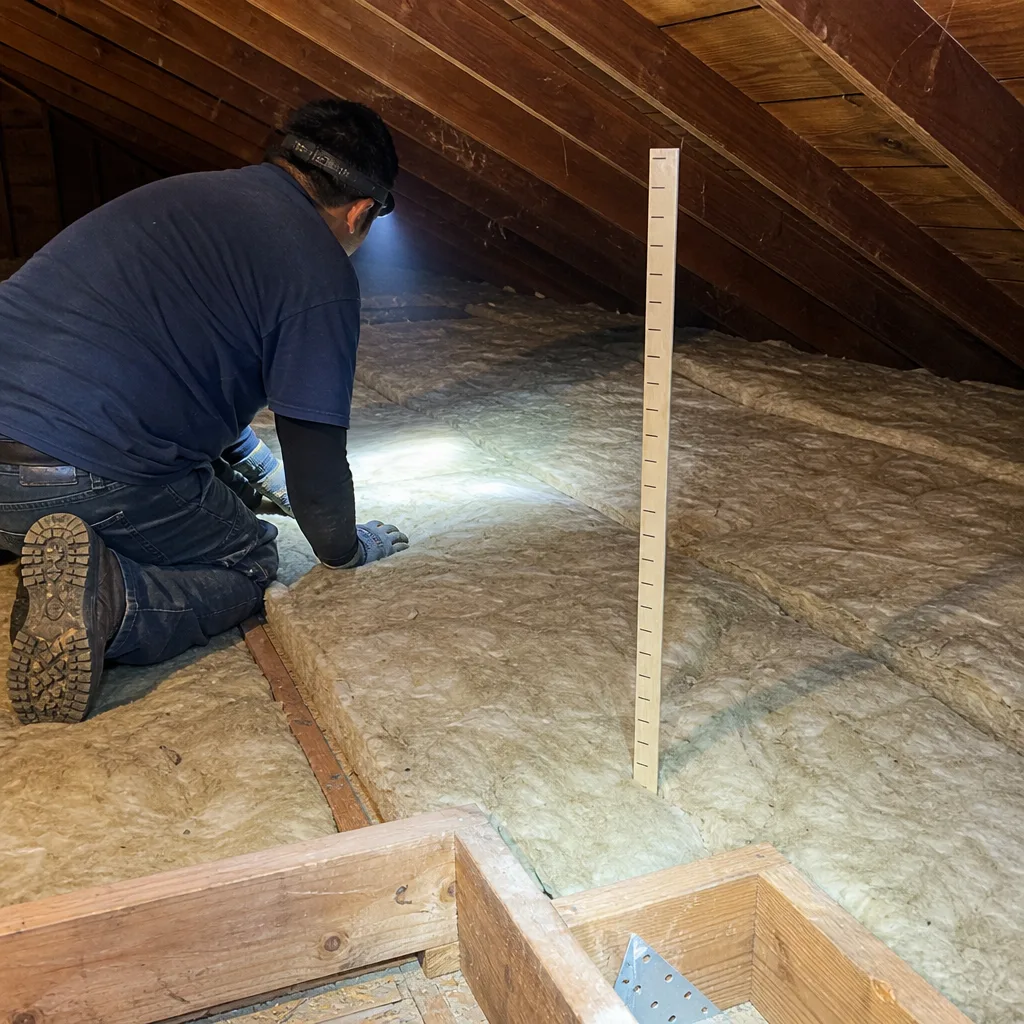
R-value, the measure of thermal resistance, also affects material volume and cost. San Diego’s building code requires R-30 minimum for attics in most of the county, but many of the homes we inspect in Tierrasanta and Poway have R-19 or less, often because that’s what code allowed when they were built. Bringing an attic from R-19 to R-38 means adding material, which increases material cost but pays back through lower SDG&E bills.
What Affects Insulation Pricing in San Diego
- Attic square footage and layout. This is the single largest cost factor. A sprawling single-story rancher in El Cajon has more attic floor area than a two-story colonial in Kensington with the same living square footage. Complex roof geometry, multiple gables, and tight knee walls all add labor hours.
- Existing insulation condition and removal needs. If we find old rock wool batts compressed to half their original depth, or rodent-damaged material in a North Park attic, removal adds time and disposal fees. Many homeowners discover their 1990s insulation has settled to R-11 effectiveness even though it was rated R-30 when installed.
- Coastal moisture and ventilation. Homes in Ocean Beach, Pacific Beach, and Point Loma face salt air and persistent humidity. That moisture can degrade fiberglass batts and create conditions where closed-cell spray foam becomes the smarter choice despite the higher upfront cost. Ventilation upgrades, like adding soffit baffles before blowing in new material, add $200 to $600 to a typical job.
- Material choice and brand. We install Owens Corning, Johns Manville, Knauf, Rockwool, CertainTeed, Icynene, Demilec, and GreenFiber. The brand and type affect material cost per square foot. A Rockwool batt costs more than a basic fiberglass batt, and closed-cell Icynene spray foam runs higher than open-cell Demilec. We recommend the material that fits your attic’s realities, not whatever happens to be on the truck.
- Air sealing scope. Most San Diego attics leak air around recessed lights, plumbing penetrations, and top plates. Sealing those gaps before insulating adds roughly $300 to $800 but dramatically improves performance. In older homes around University Heights and Hillcrest, we routinely find dozens of unsealed penetrations that negate the value of new insulation if left alone.
- Seasonal scheduling. San Diego doesn’t have a brutal winter, but late summer and early fall are peak insulation seasons as homeowners react to high cooling bills. Booking in spring can sometimes mean shorter lead times, though Woolsey’s pricing stays consistent year-round. We give you the written number before any work starts, regardless of season.
How to Save on Insulation
The most effective way to cut insulation costs in San Diego is to pair air sealing with blowing in new material during the same visit. It avoids a second mobilization and keeps the attic work contained to one day. You also save by not over-insulating beyond what your home needs. R-38 is comfortable for most San Diego attics, and going to R-60 rarely pencils out in our climate the way it might in Minneapolis.
Check for utility rebates before you commit. SDG&E and various city programs occasionally offer incentives for attic insulation upgrades, particularly for homes that started with R-19 or less. We can point you toward current programs, but we don’t handle the rebate paperwork ourselves.
The biggest money-saver is getting an honest number the first time. A free estimate from Woolsey means you’ll know the real cost before any work begins. Call (619) 344-8538 and we’ll schedule a time to walk your attic, measure it, and give you a written price. No door-step surprises, no “discovered issues” that double the bill mid-job.
Is Insulation Worth the Cost in San Diego?
For most San Diego homes, yes. The payback math works because our summers are long and our inland areas hot. An attic insulation upgrade from R-11 to R-38 typically cuts attic-related cooling costs by 20 to 30 percent. For a Chula Vista home spending $2,800 per year on electricity, that’s $560 to $840 back annually. The job pays for itself in roughly three to five years, faster if you’re in an inland ZIP code like Santee or Lakeside where summer temperatures consistently exceed 90°F.
Beyond utility bills, insulation addresses comfort problems that show up everywhere in San Diego. Hot second-story bedrooms in Mira Mesa. Cold tile floors in a Del Cerro rancher. A master bedroom in Carlsbad that never cools down even with the AC running. These are symptoms of under-insulated or improperly insulated attics, and fixing them changes how the whole house feels.
And then there’s the moisture angle. San Diego’s marine layer means cool, damp nights for coastal neighborhoods. An attic with inadequate insulation can develop condensation where warm interior air meets cooler attic surfaces. That leads to mold, wood rot, and insulation that loses its effectiveness when it gets damp. Proper insulation and ventilation work together to keep attic conditions dry.
The Kingswell Way: How a Woolsey Job Runs
Woolsey Attic Insulation operates under The Kingswell Guarantee, which matters because insulation is a trade where trust gets tested quickly. Here’s how every job runs with us.
First, you call and a real person answers. Not a voicemail maze, not a call-back window. You can reach us at (619) 344-8538 any hour, any day. We’ll schedule a visit to your home, measure your attic, and give you a written price. That price is what you pay. It doesn’t shift when the crew shows up.
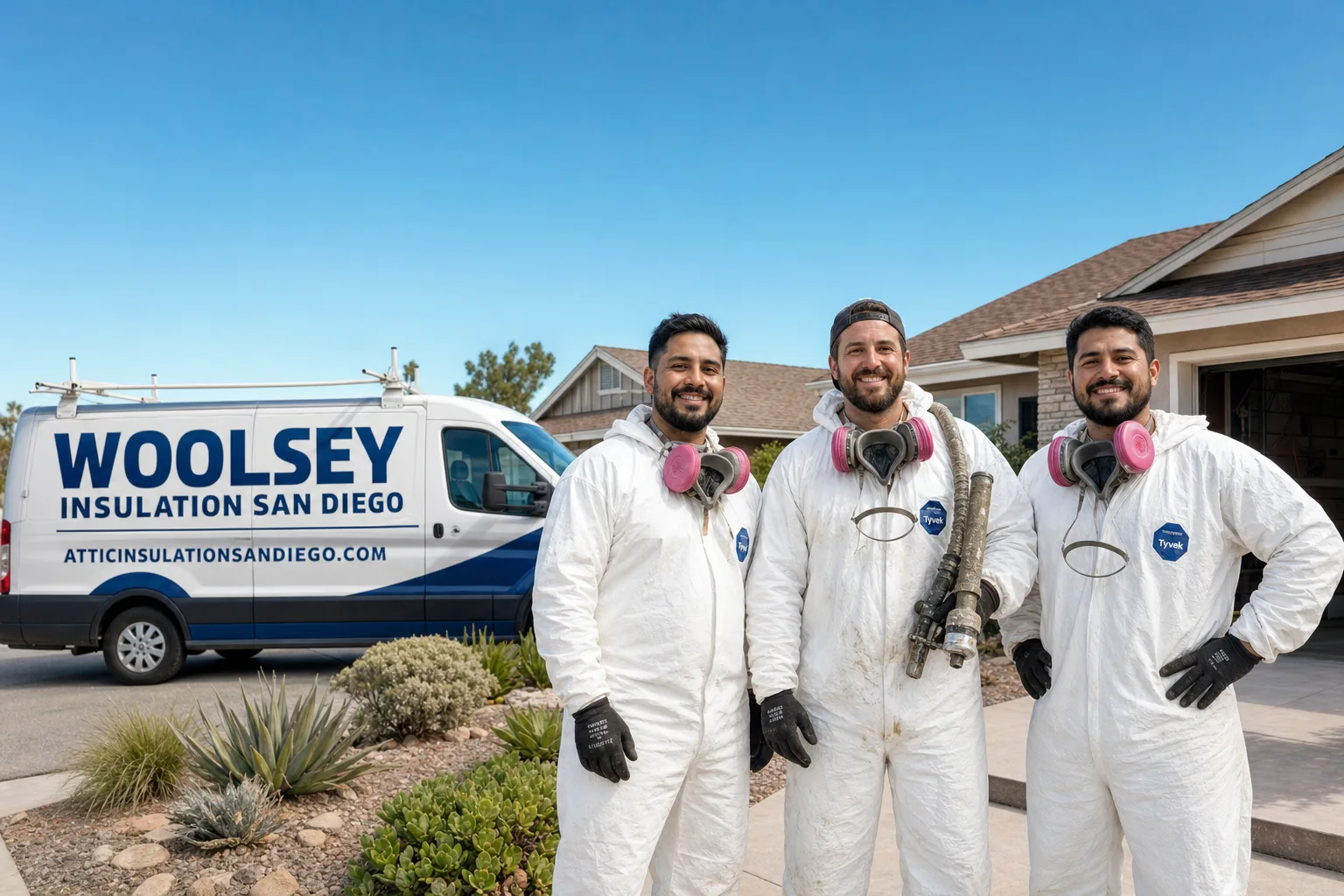
On installation day, our background-checked, uniformed technicians arrive in the window we committed to. You know exactly who is walking into your home. We lay down protection, do the work, and leave the job site cleaner than we found it. When we’re done, you get a written guarantee for the work, backed by our 365-Day Done Right Promise. If something isn’t right within 365 days, we come back and fix it at no charge. That’s in writing, on every job.
The name Woolsey connects to wool, which was the first insulation humans used. We keep the idea in the name, and we keep our promises in writing.
Blown-In vs. Spray Foam: What San Diego Homes Actually Need
Blown-in insulation, either fiberglass or cellulose, is small loose material blown across the attic floor with a machine. It fills gaps and covers irregular joist spacing easily. Cellulose, made from recycled paper treated with fire retardant, performs slightly better at blocking air movement than fiberglass of the same R-value. Both are cost-effective for standard vented attics, which describe most San Diego homes.
Spray foam insulation, a two-part liquid that expands on contact and seals gaps airtight, comes in open-cell and closed-cell varieties. Open-cell is softer, less expensive, and excellent for sound dampening. Closed-cell is denser, adds structural rigidity, and acts as both an air and moisture barrier. It’s the right choice for unvented attics, which are common in newer San Diego construction, and for coastal homes where moisture intrusion is a real concern.
We install both, using materials from Owens Corning, Johns Manville, Knauf, Rockwool, CertainTeed, Icynene, Demilec, and GreenFiber. The recommendation you get reflects your attic’s size, accessibility, ventilation setup, and moisture profile. Not what’s on sale this week.
What R-Value Do You Need in San Diego?
San Diego falls in Climate Zone 3 under California’s Title 24 energy code. That requires a minimum of R-30 attic insulation for new construction and major remodels, with R-38 recommended for most retrofit situations. Homes built before the 1980s often have R-11 or less, either because codes were looser then or because the original material has settled and compressed over 40 years.
R-value measures how well a material resists heat flow. Higher numbers mean better insulation. An attic with R-38 resists heat roughly three times better than one with R-11. For San Diego, R-38 is the sweet spot for most homes. Going higher than R-49 adds cost without proportional benefit in our moderate climate.
If you’re unsure what’s in your attic now, we’ll check during your free estimate. Many homeowners are surprised to learn their attic insulation, which they assumed was fine, measures well below current code minimums.
Attic Insulation and San Diego’s Climate: What Actually Happens Up There
Your attic in San Diego is not like an attic in Phoenix or Minneapolis, and the difference matters for what insulation you need and how much it costs to install.
In July, a San Diego attic can reach 140°F. That heat radiates down into your living space, making your air conditioner work harder. Good insulation slows that heat transfer. A properly insulated R-38 attic might reach 150°F at the roof deck but transfer far less heat into the rooms below than an R-11 attic.
But San Diego’s climate is also known for coastal fog and marine layer moisture. That damp air can condense in attics when warm interior air leaks upward and hits cooler roof surfaces at night. Fiberglass insulation loses effectiveness when damp, and repeated condensation cycles lead to mold and rot. That’s why air sealing before insulating matters so much in places like Point Loma and Coronado. Seal the air leaks, keep the attic dry, and the insulation does its job.
Inland San Diego, from Poway to Alpine, deals with bigger temperature swings. Summer days hit 100°F and nights drop to 60°F. That daily expansion and contraction stresses building materials, and the attic is where the stress concentrates. A well-insulated attic buffers those swings and keeps the living space below more stable.
How Much Does Insulation Cost for Specific San Diego Home Types?
Homes in San Diego vary widely by era and construction style, and insulation costs track those variables.
1920s-1940s craftsman and Spanish revival homes in neighborhoods like Mission Hills, South Park, and Kensington typically have small attics with restricted access, little to no existing insulation, and knob-and-tube wiring that requires special attention. Expect costs at the higher end of the blown-in range, from $2,400 to $4,000, due to access challenges and wiring considerations.
1950s-1970s ranch homes in Clairemont, Allied Gardens, and Lemon Grove usually have accessible attics with some original batt insulation, often compressed and under-performing. These homes are the most straightforward to upgrade, typically running $1,800 to $3,400 for blown-in fiberglass or cellulose with air sealing.
1980s-2000s tract homes in Scripps Ranch, Rancho Peñasquitos, and Eastlake often have R-19 to R-30 insulation already installed. Upgrading to R-38 runs $1,600 to $2,900, and these homes benefit most from air sealing work since the original construction rarely included it.
Newer homes built after 2010 in developments like Civita in Mission Valley or 4S Ranch often have code-compliant R-30 or better insulation. If you’re in one of these homes, your insulation needs are likely minimal unless you’re building out an uninsulated bonus room or finished attic.
FAQs – Insulation Cost
How much does attic insulation cost in San Diego?
Attic insulation in San Diego typically costs between $1,700 and $4,800, with most jobs landing around $3,100 for blown-in fiberglass or cellulose across a standard 1,200 to 1,800-square-foot attic. Spray foam runs higher at $3,200 to $7,500. Call (619) 344-8538 for a free written estimate on your specific home.
Is it cheaper to insulate my attic myself?
Yes, DIY batt insulation can cost as little as $600 to $1,200 for materials, but improper installation and skipped air sealing reduce effectiveness by 30 to 50 percent, meaning you pay utility bills for insulation that isn’t working. Blown-in insulation requires a blowing machine and is harder to DIY correctly. If you’d rather have the job done right the first time, we give you a written price before any work starts.
How long does insulation installation take in San Diego?
A typical attic insulation job takes 4 to 8 hours for blown-in material and one full day for air sealing plus insulation. Spray foam installations are usually complete in one day. We’ll commit to a real arrival window and show up when we say we will.
How much can I save on energy bills with new insulation?
San Diego homeowners upgrading from R-11 to R-38 typically see 20 to 30 percent reductions in cooling costs, which translates to $400 to $800 annually for most homes. Your actual savings depend on your home’s size, AC usage, and current insulation depth.
Does insulation help with heat or just cold?
Insulation resists heat flow in both directions. It keeps heat out of your San Diego home during summer and keeps conditioned air inside year-round. For a city with mild winters but hot inland summers, insulation’s biggest benefit is summer cooling cost reduction and second-story comfort improvement.
Can you replace insulation without removing the old stuff?
In many cases, yes. If existing insulation is dry, uncontaminated, and not compressed, we can blow new material on top to reach the target R-value. If the old insulation is rodent-damaged, water-damaged, or severely compressed, removal is necessary and adds $1 to $2 per square foot. We’ll tell you which situation applies to your attic during your free estimate.
Get Your Written San Diego Insulation Price
The fastest way to know what insulation will cost for your San Diego home is to call us at (619) 344-8538. A live person answers, day or night. We’ll schedule a time to inspect your attic, measure it, and give you a written price with no obligation. No door-step price changes. No surprises. Just a real number, in writing, before any work begins.
Woolsey Insulation has been part of the Kingswell family of independently owned and operated insulation companies since 2002. Led by Glenn Hartley, our San Diego team brings Kingswell’s written guarantee to every attic in the county. If the work isn’t done right within 365 days, we come back and fix it at no charge. That’s a promise in writing, not a sales line.
Call (619) 344-8538 today for your free estimate. Get the number, then decide. We’ll be here either way.
Pricing reflects the San Diego market as of 2026. Woolsey Insulation San Diego offers free estimates – call (619) 344-8538.
Written by Glenn Hartley, Owner at Woolsey Insulation San Diego, serving San Diego since 2002.
What Our Customers Say
"Spray foam in the crawlspace and new attic insulation. They wrote up the whole price and the two jobs came in exactly as quoted. Floors upstairs aren't freezing in the morning anymore."
- Nathan Pruitt"The guy didn't try to sell me on foaming the whole house. He said the attic was where I'd actually feel it and left it at that. Honest, and he was right, our bills dropped."
- Angela Ruiz"Our old insulation was flattened and basically useless. They removed it, cleaned up, and blew in new. Furnace isn't running constantly anymore and the first bill already showed it."
- Carl Yeung