
How Much Does Blown-In Insulation Cost in San Diego?
Blown-in insulation in San Diego typically costs between $1,800 and $4,200 for a standard 1,500-square-foot attic, with most homeowners paying around $2,600. For wall cavity retrofits, expect $2,800 to $6,500 depending on access and wall count. We give every homeowner a written price before any work starts, so the number you’re quoted is the number you pay, never a penny more.
Before we get into the detailed pricing, here’s the short version: if you’re insulating an existing attic to R-38 (the recommended level for San Diego’s climate zone), you’re looking at roughly $1.75 to $3.25 per square foot of attic space. That covers material removal if needed, air sealing, new blown-in material, and cleanup. The total depends mostly on your home’s square footage, current insulation condition, and attic accessibility.
Blown-In Insulation Cost Breakdown (2026)
Costs vary by material type and job scope. Here’s what we’re seeing across San Diego County in 2026, from Chula Vista up to Oceanside and east through El Cajon and Poway:
| Job Component | Typical Cost Range (San Diego, 2026) |
|---|---|
| Fiberglass blown-in (attic, R-38) | $1,800 – $3,400 |
| Cellulose blown-in (attic, R-38) | $2,000 – $3,800 |
| Existing insulation removal | $1,200 – $2,500 |
| Air sealing (attic floor penetrations) | $450 – $1,100 |
| Blown-in for existing walls (per wall section) | $900 – $2,200 |
| Whole-home wall retrofit (1,500 sq ft home) | $2,800 – $6,500 |
| Attic hatch/access insulation and sealing | $75 – $200 |
| R-60 upgrade (increased depth) | Add $1,100 – $2,600 to base attic cost |
What moves a job toward the higher end of those ranges? If your attic has old fiberglass batts that need pulling, if the roof pitch makes the attic tight and slow to work in, or if there’s rodent damage requiring cleanup first, the labor hours climb. Homes in Tierrasanta and Scripps Ranch with vaulted ceilings and limited attic access often land at the upper end because access hatches are small and crews move slower. Single-story ranchers in Clairemont with wide-open attics and easy stair access typically land at the lower end.
Material choice matters too. Fiberglass is lighter and settles less over time, while cellulose, made from recycled paper treated with borate for fire and pest resistance, provides slightly better R-value per inch. We work with eight brands, including Owens Corning, Johns Manville, Knauf, Rockwool, CertainTeed, Icynene, Demilec, and GreenFiber, so the material we recommend fits your home’s structure and your budget, not whatever happens to be left on the truck.
What Affects Blown-In Insulation Pricing in San Diego
Here are the factors that actually move the number on your quote. None of these are mysterious. We walk through each one with you before you sign anything.
- Attic square footage. The single biggest driver. A 900-square-foot condo attic in Mission Valley costs less than a 2,400-square-foot attic in Rancho Bernardo, simple as that. Most quotes work out to $1.75 to $3.25 per square foot of attic floor.
- Current insulation condition and R-value. If your attic has old, compressed fiberglass batts that no longer perform, removal adds labor and disposal fees. If the attic is bare, you skip removal and go straight to installation. Homes built before 1980 in neighborhoods like North Park and Normal Heights often have old insulation that’s flattened to half its original R-value.
- Type of material. Fiberglass runs slightly less than cellulose per square foot. But cellulose packs tighter and performs better in exterior wall cavities, so the choice isn’t just about cost. For attics, both work well at R-38 in San Diego’s mild coastal climate.
- Attic access and roof geometry. Low-slope roofs, tight scuttle holes, and a maze of trusses slow a crew down. Homes with accessible pull-down stairs in the hallway beat homes where we’re climbing through a bedroom closet hatch.
- Air sealing scope. If you want the full performance benefit, we seal the attic floor penetrations (recessed lights, ceiling fan boxes, wire chases, top plates) before blowing insulation. It adds $450 to $1,100 but it’s the difference between insulation that works and insulation that’s just filling space.
- Climate zone considerations. San Diego sits in climate zone 3, where the Department of Energy recommends R-38 in the attic. Coastal homes in La Jolla and Point Loma don’t need the same depth as inland homes in Santee or Alpine where summers hit triple digits. That said, we still recommend R-38 across the board because it works well in both conditions and the cost difference between R-30 and R-38 is small.
Why San Diego Homeowners Are Insulating Now
Here’s a local reality: SDG&E’s electric rates have climbed steadily for a decade. Running air conditioning through a San Diego summer, especially in east county where July and August stay above 90 degrees, costs real money when your attic is under-insulated. A properly insulated attic with air sealing keeps the cooled air in your living space instead of losing it through the ceiling. That’s why we’re regularly called out to homes in El Cajon, Lakeside, and Spring Valley where homeowners see their AC cycling nonstop and their July bill approaching $400 or more.
Winter works the other direction. Coastal mornings in Ocean Beach and Pacific Beach drop into the 40s. Without adequate attic insulation, heated air rises straight through the ceiling and out the roof. Your furnace runs harder, and the upstairs bedrooms still feel cold. The fix is the same: air seal, blow to R-38, and stop the thermal exchange.
Rodent intrusion is another San Diego reality, especially in older neighborhoods with mature trees, like Kensington and Talmadge. Rats and squirrels tear up existing insulation, compress it, and leave waste behind. When that happens, removal is non-negotiable before new insulation goes in. We see this often enough that it’s a standard part of our inspection process.
How to Save on Blown-In Insulation
Saving money on insulation isn’t about cutting corners. It’s about doing the right job once, with the right scope, and not paying for work you don’t need. Here’s what actually helps:
- Get a real inspection first. We measure the attic, check current R-value, inspect for air leaks, and assess access before we quote. That inspection is free. You find out exactly what you need and what you don’t.
- Bundle air sealing with insulation. Doing both at once saves a trip charge and the disruption of having crews back twice. Air sealing without insulation is incomplete. Insulation without sealing is wasteful. Together, they work.
- Ask about SDG&E rebates. SDG&E and local programs occasionally offer insulation rebates. We don’t control those programs and can’t promise what’s active, but we’re happy to point you to the right place to check. The math changes when a rebate covers part of the material cost.
- Don’t over-buy insulation depth. R-38 is the recommended level for San Diego. Going to R-60 adds cost but the marginal benefit in our climate is small unless you have specific comfort issues in a second-story bedroom or bonus room. We won’t push you into more material than the home needs.
- Fix the access point. The attic hatch is often the leakiest spot in the entire thermal envelope. Insulating and weather-stripping the hatch costs under $200 and stops a surprising amount of air movement. It’s a small line item with big comfort returns.
For a clear picture of what blown-in insulation looks like in practice around San Diego, our Blown-In Insulation in San Diego page covers the installation process, material options, and what a typical job day looks like. If you’re in home research mode, that page plus this pricing guide should give you everything you need to make a confident decision.
How a Woolsey Insulation Job Runs
We follow what we call The Kingswell Way on every job. It’s not a slogan. It’s four steps, each with a specific promise attached.
Step one: the written price. We inspect your attic, measure everything, and hand you a written quote before any work begins. That quote includes material, labor, removal if needed, air sealing if selected, and cleanup. The number on that paper is the number you pay. No add-ons at the door. No “we found something unexpected” surprises. If we find an issue during the inspection, it’s in the quote, not sprung on you later. Wool was the first insulation. Woolsey keeps the idea in the name, and keeping promises is the same idea.
Step two: the arrival window. We commit to a real arrival window, not a four-hour “sometime between 8 and noon” guess, and we stick to it. Background-checked, uniformed technicians arrive with your name on the work order and the material loaded for your specific job. You know exactly who’s walking into your home.
Step three: the job site. Blown-in insulation creates dust. We lay down protective coverings, run hoses carefully, and when we’re done, we leave the area cleaner than we found it. That’s a written commitment, part of the Kingswell Guarantee on every job.
Step four: the written guarantee. Every installation includes a written guarantee. And here’s the part that matters: the 365-Day Done Right Promise. If anything isn’t right within 365 days of the job, we come back and make it right at no charge. That’s in writing, every time.
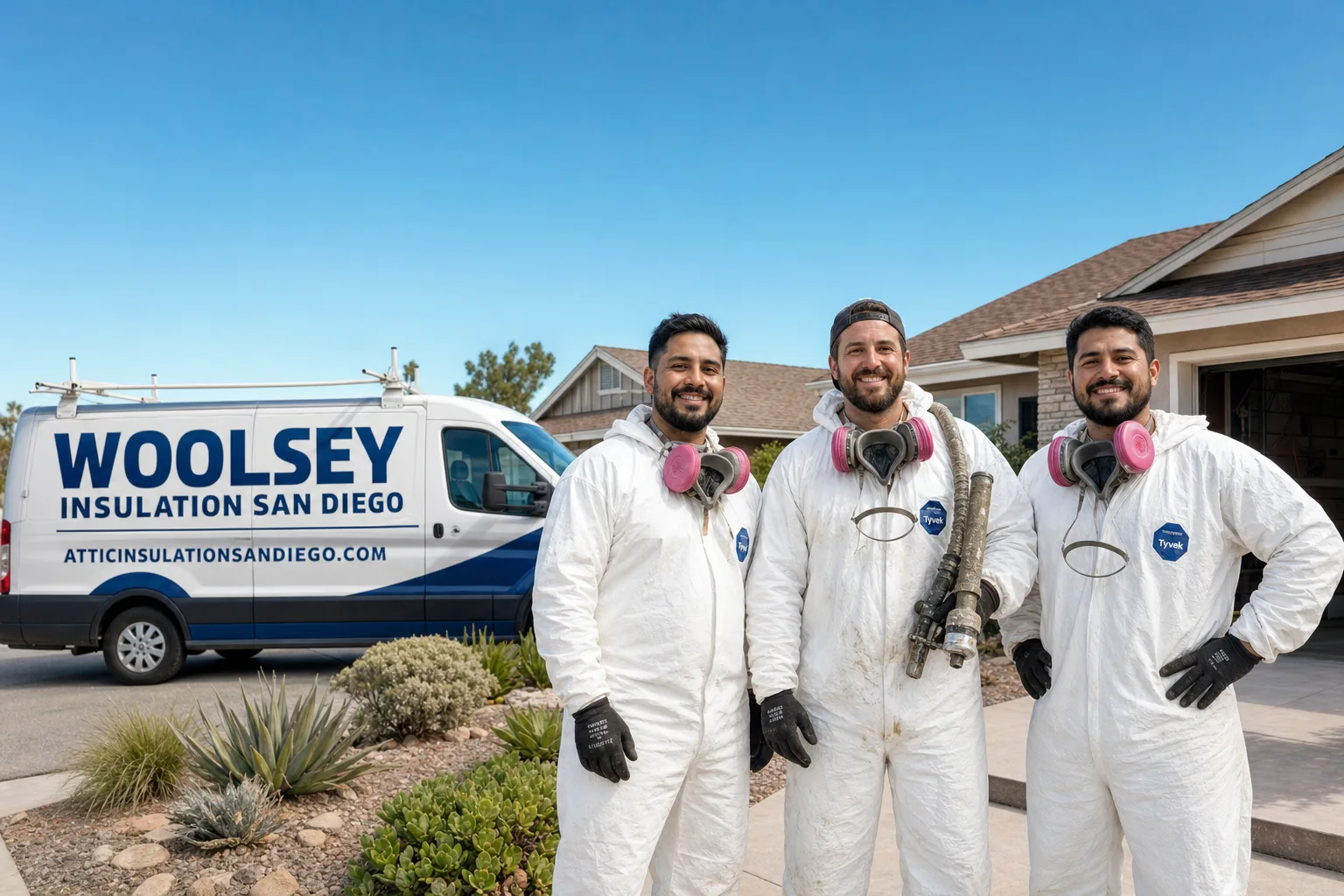
Glenn Hartley, who leads our San Diego team, started with the Kingswell family of independently owned and operated insulation companies in 2002. Since then, he’s built our San Diego operation on one hard rule: every promise goes on paper. If it’s not written down, it doesn’t exist. That’s why our written price, our arrival window, our cleanup standard, and our guarantee are all documented before the first crew member arrives, and why our phone line is answered by a live person 24 hours a day, 7 days a week. No voicemail maze. No call-back window. Just a real person who can help.
Blown-In Insulation vs. Other Options: What’s the Real Difference?
You might be weighing blown-in against fiberglass batts or spray foam. Blown-in insulation wins on cost and coverage in most San Diego attics. Here’s the honest comparison.
Fiberglass batts are the pink rolls you see at home improvement stores. They’re fine for open wall cavities during new construction, but in an existing attic they leave gaps around trusses, plumbing vents, and electrical boxes. Gaps mean air movement, and air movement means your insulation is underperforming. Blown-in fiberglass or cellulose fills those irregular spaces completely, creating a continuous thermal blanket across the attic floor.
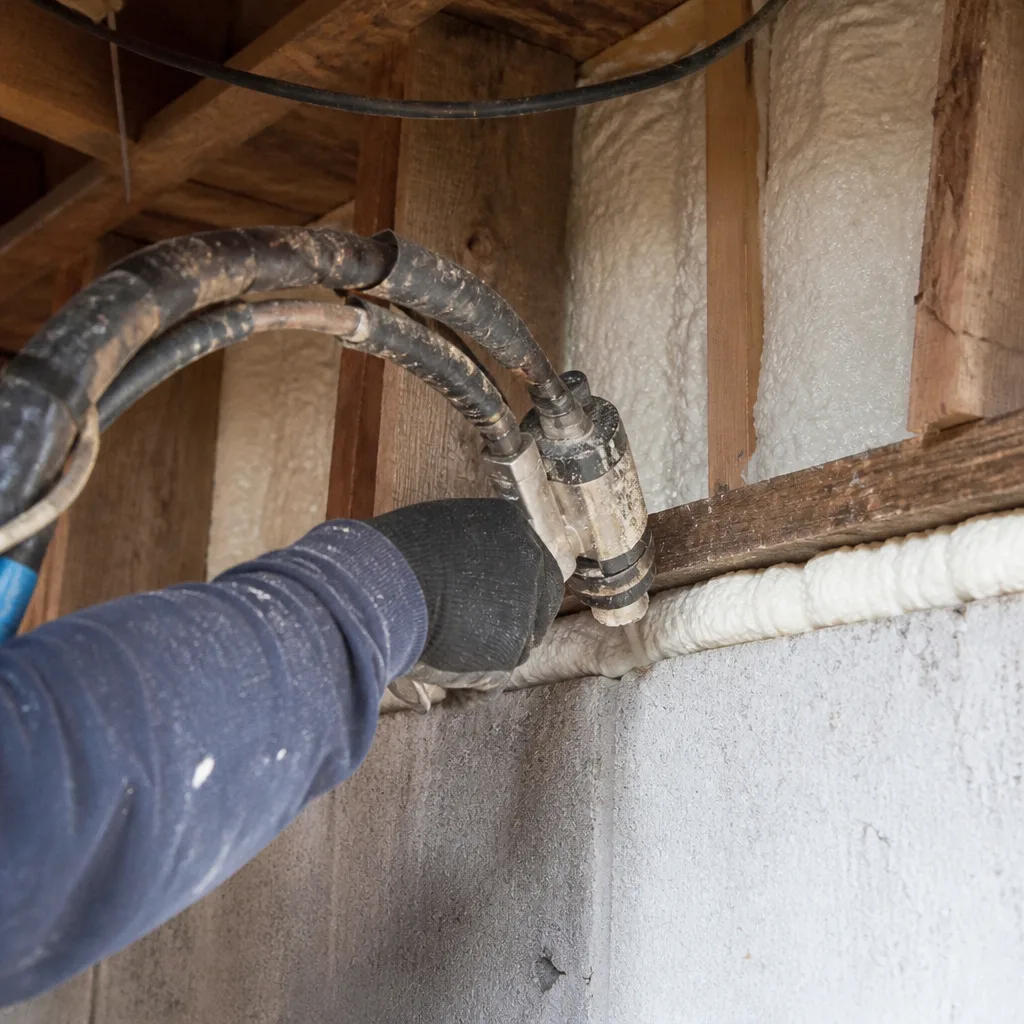
Spray foam, which we also install, costs $3,500 to $8,500 for attic applications and works differently: it expands on contact and seals gaps airtight while providing insulation. It’s the highest-performance option, with a higher price to match. In some San Diego homes, especially those with cathedral ceilings, HVAC equipment in the attic, or severe air leakage, spray foam is the right call. But for a standard vented attic in Clairemont or Carlsbad, blown-in at R-38 is the smarter financial decision, with most of the comfort benefit at a quarter of the cost.
Our team installs both. We won’t steer you to one or the other based on margin. The inspection tells us which material fits your home’s structure, your budget, and your comfort goals.
What Does R-38 Mean for San Diego Specifically?
R-value measures resistance to heat flow. Higher R-value, more resistance, better performance. The Department of Energy splits the country into climate zones; San Diego County falls mostly in zone 3, with the mountains east of Alpine and Pine Valley in zone 6. For zone 3, the DOE recommends R-38 in the attic. That’s roughly 12 to 14 inches of blown-in fiberglass or 10 to 11 inches of cellulose, depending on the specific product’s R-value per inch.
Here’s a San Diego-specific data point that rarely appears on generic insulation articles: our coastal marine layer. Neighborhoods west of Interstate 5, from Imperial Beach to La Jolla, see nighttime and morning fog for much of the year. That fog brings moisture. Attics with poor ventilation and old insulation can develop mold and damp compressed material. We see it regularly in Point Loma and Ocean Beach, homes built in the 1950s and 1960s with original insulation that’s absorbed decades of marine air. In those cases, old material removal is part of the job, and the new blown-in product we use is treated to resist moisture and pest intrusion.
For the rest of the county, the bigger thermal concern is radiant heat from the sun. Inland areas like Escondido, San Marcos, and Ramona hit 95 to 105 degrees in August and September. The attic becomes an oven, often reaching 140 degrees or more. That heat radiates down through the ceiling into your living space. Blown-in insulation at R-38 interrupts that transfer, which is why attic insulation makes a bigger comfort difference in east county than it does on the coast.
How We Price: No Door-Step Variables
A common complaint we hear from San Diego homeowners is the shifting number. The quote over the phone says one thing, the guy at the door says another, and a week later there’s an “unforeseen condition” that adds $600. That model is broken. It punishes homeowners for not being insulation experts.
Our model works differently. The inspection is free. The quote is written. The price is final before any work starts, every single time. If your attic has old insulation that needs removal, it’s in the quote. If your access hatch is tight and labor hours go up, it’s in the quote. If you want air sealing done, it’s a separate line item you approve or decline. You make decisions with complete information and a fixed number in hand.
If you want to talk through your attic’s specific situation, call (619) 344-8538 and you’ll get a live person on the first ring. No call-back windows. No voicemail tag. You describe your home, we ask the right questions, and we book a free inspection at a time that works for you.
FAQs – Blown-In Insulation Cost
How much does blown-in insulation cost per square foot in San Diego?
Blown-in insulation for attics in San Diego runs $1.75 to $3.25 per square foot of attic floor space, including material, labor, and cleanup. For a 1,500-square-foot attic, that’s $2,600 to $4,900 total depending on material choice, removal needs, and access. Wall retrofits cost more per square foot because the work is slower and more labor-intensive. Call (619) 344-8538 to get an exact written quote for your home, free of charge.
Is blown-in insulation cheaper than spray foam?
Yes, blown-in insulation at R-38 in an attic costs roughly $1,800 to $4,200 in San Diego, while spray foam for the same attic typically runs $3,500 to $8,500. Blown-in is the right financial choice for most vented attics, while spray foam earns its higher price in cathedral ceilings, unvented attics, or homes with severe air leakage that need the airtight seal only foam provides. We install both and recommend based on your attic’s actual condition.
How much does it cost to remove old insulation before blowing in new?
Old insulation removal in San Diego costs $1,200 to $2,500 for a typical attic, depending on the amount of material, whether it’s contaminated by rodents or moisture, and attic accessibility. Removal is necessary when insulation is water damaged, pest-infested, or compressed below useful R-value. We’ll tell you during the free inspection whether removal is required or if we can blow over the existing material.
Does blown-in insulation save money on energy bills in San Diego?
Homeowners who upgrade from minimal or degraded attic insulation to a properly air-sealed R-38 installation typically see their cooling and heating costs drop by 15% to 25%, based on SDG&E usage patterns we’ve observed across hundreds of San Diego jobs. The exact number depends on your current insulation, home size, and how much you run the AC. The savings in east county, where summer heat is most intense, tend to be larger than in coastal areas.
Can you do blown-in insulation the same week?
In most cases, yes. Between our inspection schedule and crew availability across San Diego County, we can typically inspect within a few days of your call and install within the same week or the following week. Blown-in attic jobs are usually completed in a single day. Call (619) 344-8538 and we’ll give you real scheduling options for your neighborhood.
How long does blown-in insulation last in San Diego’s climate?
Blown-in fiberglass and cellulose insulation lasts 20 to 30 years or longer when properly installed and kept dry. San Diego’s mild, low-precipitation climate is gentle on insulation compared to regions with heavy snow or humidity, but marine-layer moisture in coastal neighborhoods, rodents, and roof leaks can shorten that lifespan. If your insulation is older than 20 years, an inspection is worth the time.
Call for a Free Blown-In Insulation Estimate in San Diego
Here’s the bottom line you came for: blown-in insulation in San Diego costs between $1,800 and $4,200 for most attics, and the exact number for your home depends on your square footage, current insulation condition, and access. You can find that exact number with one free inspection, and you’ll have it in writing before you commit to anything.
Call (619) 344-8538 to schedule your free inspection. A live person answers, 24/7. We’ll measure your attic, assess what’s there now, and give you a written quote that covers material, labor, air sealing if needed, and cleanup. No shifting numbers, no door-step surprises, and a 365-day written guarantee that backs the work. Glenn Hartley and the Woolsey Insulation San Diego team are ready when you are.
Written by Glenn Hartley, Owner at Woolsey Insulation San Diego, serving San Diego County since 2002.
Pricing reflects the San Diego market as of 2026. Woolsey Insulation San Diego offers free estimates – call (619) 344-8538.
What Our Customers Say
"Our old insulation was flattened and basically useless. They removed it, cleaned up, and blew in new. Furnace isn't running constantly anymore and the first bill already showed it."
- Carl Yeung"Upstairs was always ten degrees hotter than downstairs in summer. They added attic insulation and the difference is night and day. Written price up front, no add ons at the end."
- Edith Marlowe"Good work and a fair price on spray foam in the garage. The crew did track a bit of the old insulation through the garage, but they vacuumed it up before they left. Garage is way warmer now."
- Brenda Falk