
How Much Does Wall Insulation Cost in San Diego?
Wall insulation in San Diego typically costs between $1,800 and $6,400 for a standard single-family home, with most homeowners paying around $3,200 to $4,500. The exact number depends on the wall type, insulation material, and square footage. We give you a written price before any work starts, so the number we quote is the number you pay.
If you’re looking for a per-square-foot figure, expect to pay $1.50 to $4.50 per square foot for blown-in wall insulation and $2.50 to $7.00 per square foot for spray foam. San Diego’s mild climate means you’ll usually be at the lower end of national averages, but older homes with no existing insulation in the walls can push costs higher due to drilling and patching access holes.
Wall Insulation Cost Breakdown (2026)
Here’s what wall insulation actually costs in San Diego right now. These ranges reflect real quotes from our jobs across the county, from Chula Vista to Oceanside to El Cajon.
| Insulation Type | Cost per Sq. Ft. | Typical 1,200 Sq. Ft. Wall Area | Best For |
|---|---|---|---|
| Blown-in (loose-fill) fiberglass | $1.50 – $2.50 | $1,800 – $3,000 | Older homes with empty wall cavities |
| Blown-in cellulose | $1.75 – $3.00 | $2,100 – $3,600 | Dense-pack, good sound control |
| Open-cell spray foam | $2.50 – $4.50 | $3,000 – $5,400 | Interior walls, soundproofing |
| Closed-cell spray foam | $4.00 – $7.00 | $4,800 – $8,400 | Exterior walls, max R-value per inch |
| Fiberglass batts (new construction or open walls) | $1.00 – $1.75 | $1,200 – $2,100 | New builds, remodels with drywall off |
Those numbers include labor, materials, and cleanup. What they don’t include are the surprises some contractors add at the door: access fees, disposal charges, fuel surcharges. We don’t do that. The written price we give you before work starts is the final price, guaranteed under The Kingswell Guarantee.
So what moves those numbers up or down? Wall height, for one. A lot of San Diego homes built between 1950 and 1980 have 8-foot walls, which are straightforward. But if you’re in a newer development in 4S Ranch or Otay Ranch with 9- or 10-foot ceilings, you’re paying for more material per square foot of wall. Stud spacing matters too: 24-inch on-center studs mean fewer cavities to fill than 16-inch spacing, which raises labor time. And if your walls have old knob-and-tube wiring or previous insulation that needs removal first, the job gets more involved.
What Affects Wall Insulation Pricing in San Diego
- Wall access method. If your walls are already open (remodel), insulation is cheap to install. If they’re closed, the crew has to drill access holes through drywall or stucco, fill the cavities, then patch. That drilling and patching adds $1.00 to $2.00 per square foot. Most San Diego homes need the drill-and-fill approach, which is why blown-in cellulose and fiberglass are the workhorses here.
- The home’s age and framing style. A 1950s Clairemont or Allied Gardens home with balloon framing (wall cavities that run unbroken from foundation to attic) insulates faster than a 1970s platform-framed house with blocking between floors. Balloon framing in those older neighborhoods means fewer access holes per stud bay, which trims labor time by 20 to 30 percent.
- Stucco versus lap siding. Stucco is harder to patch invisibly after drill-and-fill. A good patch on textured stucco takes longer than one on wood lap siding. In neighborhoods like Mission Hills or Point Loma where original stucco texture matters, expect modestly higher patch costs, usually $150 to $400 depending on texture matching.
- Insulation material choice. Closed-cell spray foam costs more to install but delivers the highest R-value per inch (around R-6.5 to R-7) and acts as an air and moisture barrier in one step. There’s a reason it’s popular in coastal areas where marine-layer moisture pushes into walls. Cellulose and fiberglass are cheaper, and in San Diego’s climate they’re perfectly adequate for most homes.
- Existing insulation removal. Some San Diego homes, especially those built in the 1980s and 1990s, have original fiberglass batts that have slumped. Removal and re-insulation costs $0.50 to $1.00 per square foot extra.
- Access and obstructions. Trees, fencing, and narrow side yards make ladder and scaffolding work harder. Most San Diego lots are tight, especially in areas like North Park, South Park, and Normal Heights. That’s not a complaint; it’s just geometry. The quote accounts for it up front.
Wall Insulation Materials: What We Install and Why
We work with eight insulation brands: Owens Corning, Johns Manville, Knauf, Rockwool, CertainTeed, Icynene, Demilec, and GreenFiber. That’s not name-dropping. It means the recommendation you get fits your home, not whatever happens to be on the truck. Here’s how the materials shake out in San Diego’s climate.
Blown-In Fiberglass
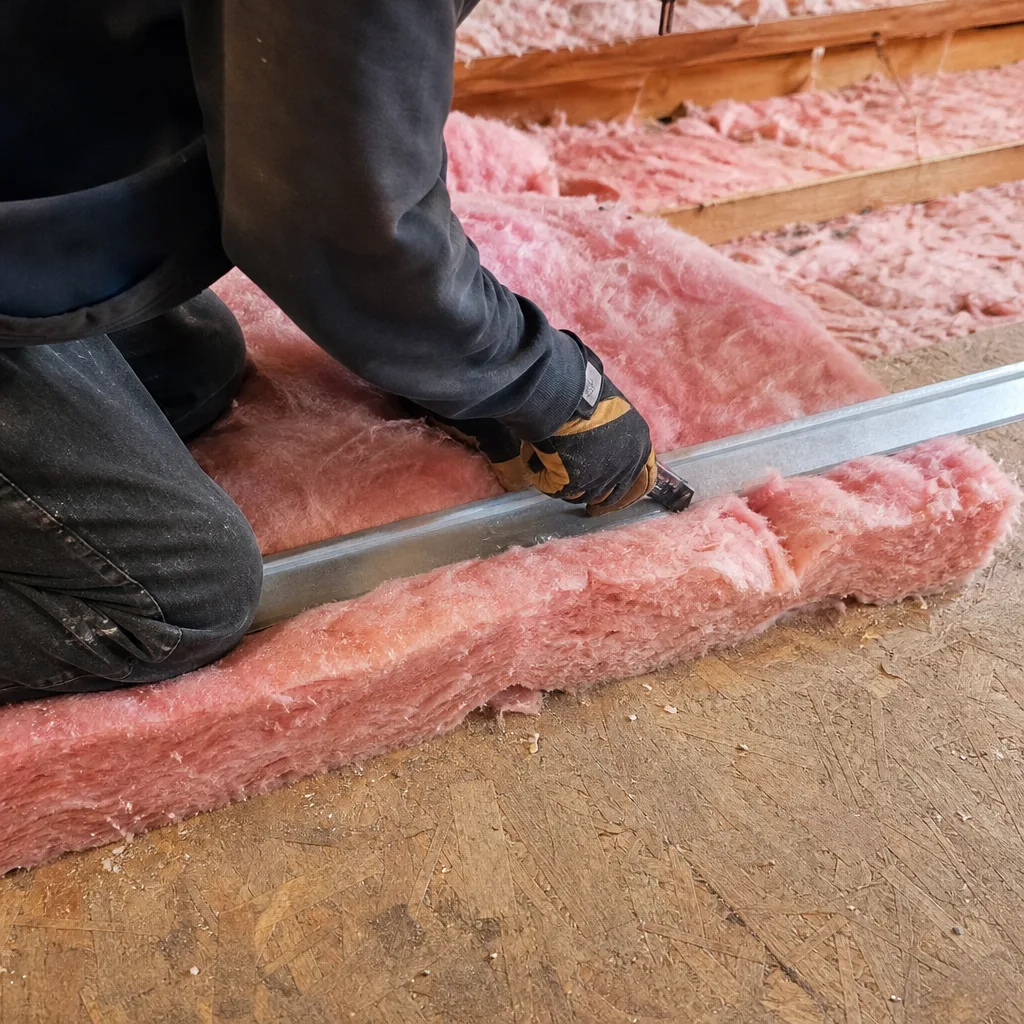
Loose-fill fiberglass is the budget workhorse. It’s made from tiny glass fibers that are blown into wall cavities under pressure, filling odd shapes and around pipes and wires. R-value runs about R-2.2 to R-2.7 per inch. For a 2×4 wall, you’ll get around R-11 to R-13. It’s not the highest performer, but it’s predictable and dry. In San Diego’s mild climate, that’s often enough.
Blown-In Cellulose
Cellulose is recycled paper treated with borates for fire and pest resistance. It packs denser than fiberglass, which gives it better sound control, and it does a slightly better job slowing airflow. R-value is R-3.2 to R-3.8 per inch. In Carlsbad, Encinitas, and La Jolla, where homeowners often ask about street-noise reduction, we recommend dense-pack cellulose more often than fiberglass.
Open-Cell Spray Foam
Spray foam is a two-part liquid that expands on contact and seals gaps airtight. Open-cell foam is the lighter, less expensive version. It expands to about 100 times its liquid volume and creates a sponge-like structure. R-value is R-3.5 per inch. It’s good inside walls where you want sound dampening and an air seal, and it’s forgiving if the house shifts slightly over time.
Closed-Cell Spray Foam
Closed-cell is the premium option: denser, stronger, and R-6.5 to R-7 per inch. It acts as a vapor retarder and adds structural rigidity. For exterior walls in coastal zones where salt air and marine moisture press on building envelopes, closed-cell does a job nothing else can. It’s also the most expensive wall insulation we install, and the upfront cost only makes sense if you’re planning to stay in the home long-term or you’re dealing with a specific moisture issue.
When You Should Insulate Your Walls in San Diego
San Diego’s climate hides wall insulation problems well. It rarely gets freezing. Summer heat spikes but doesn’t linger. So a lot of homeowners don’t notice the hole in their wallet until the electric bill shows up in August or the bedroom wall facing west turns warm to the touch at 6:00 p.m.
Here are the signs worth acting on:
- Rooms that run 5 to 8 degrees warmer or cooler than the rest of the house, especially west-facing rooms in the afternoon. In Rancho Peñasquitos and Scripps Ranch, where summer heat sits on the mesas, we hear this one constantly.
- Walls that feel warm or cold to the touch compared to interior walls. Put your palm on an exterior wall in the late afternoon. If it’s noticeably warm, there’s heat soaking through the framing.
- Homes built before 1980 that were never re-insulated. Many houses from the 1950s and 1960s in San Diego were built with wood shavings or no wall insulation at all. If your wall cavities are empty or nearly empty, any insulation you add will transform comfort.
- SDG&E bills that spike from June through October. Wall insulation doesn’t just affect the walls. It slows the heat exchange between outside air and the interior envelope, which means your AC isn’t fighting an uninsulated box.
- Outside noise carries inside. Cellulose and spray foam dampen sound. If you live near the 5, the 8, or the 805, or under the Lindbergh flight path in Point Loma, dense insulation in exterior walls is the most honest sound-reduction step you can take.
How Wall Insulation Works (And What R-Value Actually Means)
R-value is the insulation industry’s way of measuring resistance to heat flow. The higher the number, the slower heat moves through the material. A 2×4 wall cavity is 3.5 inches deep. Fill it with blown-in fiberglass (R-2.5 per inch) and you get about R-9. Fill the same cavity with closed-cell spray foam (R-6.5 per inch) and you get R-22. That’s the whole conversation in two numbers.
San Diego is in climate zone 3, which is mild by national standards. The Department of Energy recommends R-13 to R-15 for wall cavities in our climate, or R-20+ if you’re using a material that also provides an air barrier. The truth is that in our climate, air sealing often matters more than raw R-value. A wall with R-13 insulation and a tight air seal outperforms a wall with R-19 insulation and cracks where air leaks through. That’s why spray foam, which seals as it insulates, punches above its R-value weight in coastal San Diego homes.
Should You Insulate Interior Walls Too?
Interior wall insulation in San Diego runs $1.20 to $2.50 per square foot, with the most common application being sound control between bedrooms, bathrooms, and living areas. If your teenager’s bedroom shares a wall with the living room, or if the master bathroom flushes directly into the kitchen wall, interior insulation with blown-in cellulose or open-cell foam is a modest-cost fix that makes a meaningful difference. We do interior wall insulation regularly in newer tract homes in Poway and Mira Mesa, where builders of the 1990s and 2000s often left interior walls empty to save money.
How the San Diego Permitting and Code Picture Affects Cost
Most wall insulation jobs in San Diego don’t require a city permit if the work doesn’t involve structural changes. Drilling access holes and filling cavities is considered maintenance, not construction. If you’re doing a remodel where walls are open, the broader remodel permit covers the insulation work.
What does apply is California’s Title 24 energy code. If your walls are opened during a remodel, the new insulation must meet current efficiency standards; you can’t stuff new spaces with R-11 fiberglass batts and call it done. That’s a Sacramento rule, not a San Diego one, but it affects project costs here because it often pushes material choices up the R-value ladder. Our written estimate will flag any Title 24 compliance issues before we start, so there’s no mid-job surprise.
For older homes with lath-and-plaster walls (common in Mission Hills, Kensington, and Bankers Hill), the drilling process is more delicate. Plaster cracks more easily than drywall, and a careless contractor can turn a simple insulation job into a wall-repair project. Our crews have spent enough years on those older San Diego homes to know how to drill clean access holes without wrecking a 90-year-old wall surface.
How to Save on Wall Insulation in San Diego
Saving money on wall insulation isn’t about finding the cheapest per-square-foot bid. It’s about not paying for what you don’t need and not getting surprised by what you didn’t expect. Here’s what actually moves the number:
- Ask for a written, line-item price before any work begins. This single step protects you from the most common overcharge in the insulation trade: the mid-job “we found something” price bump. Our jobs start with a written price delivered before any work. Under The Kingswell Guarantee, that’s not a courtesy. It’s the way we operate.
- Don’t overbuy R-value. San Diego doesn’t need R-22 in every wall. In climate zone 3, R-13 with proper air sealing is appropriate for most homes. Closed-cell foam in every wall cavity is a defensible choice if you’re doing a forever-home build, but for most existing San Diego homes, blown-in cellulose or fiberglass hits the comfort and efficiency mark at a fraction of the foam cost.
- Combine wall insulation with attic work if you can. Attics are the biggest energy loser in most San Diego homes. If your attic is under-insulated (most are), doing both jobs in one visit can trim the per-trip cost. Ask about combined pricing when you call for a free estimate at (619) 344-8538.
- Watch for manufacturer rebates. Owens Corning and Johns Manville run regional rebate programs periodically, and CertainTeed offers a modest incentive on some products in California. We’ll flag any current rebate that applies to your job when we write the estimate.
- Do the access prep yourself where it’s simple. If the crew doesn’t have to move a packed storage wall or work around a hoarder’s garage in a tight La Mesa bungalow, labor time drops. It’s not glamorous, but two hours of clearing work paths before we arrive can save real money.
The most reliable way to save is to get an honest, complete price from the start. Our wall insulation service in San Diego includes a free written estimate with no obligation. Call (619) 344-8538 and we’ll send someone out to measure, inspect, and give you the number before any work starts.
How a Wall Insulation Job Runs With Woolsey
If you’re going to spend $3,000 or more on insulation, you should know exactly how the job unfolds before you sign. Here’s the sequence we follow on every wall insulation job in San Diego, and what makes it different from the contractor who left you waiting around last time.
Step one: the written estimate. You call, a real person answers 24/7, and we schedule a site visit. We measure the wall area, inspect the existing insulation if any, check stud spacing and wall construction, and note any access challenges. Then you get a written price. That’s what the job costs. No door-step revisions, no “we discovered something.” If we find something during the estimate, it’s in the estimate.
Step two: the arrival window. We give you a committed arrival window and we show up inside it. The Kingswell Guarantee doesn’t do vague “sometime between 9 and whenever” windows. You get a real window, and the crew shows up during it. Background-checked, uniformed technicians knock on the door, and you know exactly who’s walking into your home.
Step three: the work. For drill-and-fill jobs, we drill access holes, fill the cavities to verified density, and patch the holes. For open-wall jobs, we install batts or spray foam directly into the bays. We protect floors and furniture, because a clean job site is part of the guarantee, not a bonus feature.
Step four: the written guarantee. Every job carries a written guarantee. If the work isn’t right within 365 days, we come back and fix it at no charge. The 365-Day Done Right Promise is in writing, included on every job, not an upsell.
DIY Wall Insulation: The Honest Picture
Some homeowners look at the numbers and wonder if they can tackle wall insulation themselves. For open-wall projects during a remodel, yes: installing fiberglass batts between exposed studs is genuinely approachable for a confident DIYer, and the material costs $0.80 to $1.50 per square foot.
For closed-wall drill-and-fill work, the answer is different. The equipment is the first obstacle: a proper insulation blower with enough pressure to dense-pack a wall cavity costs $500 to $1,500 to rent or buy, and the rental units at big-box stores are built for attic work, not wall cavities. Wall cavities need higher pressure to fill properly without voids. Patch work is a skill: drilling through stucco without cracking it, patching so the texture matches, and paint-matching an existing San Diego wall color all take practice. If you get any of it wrong, you create cold spots in the wall, cracked stucco that lets moisture in, or a patch job that shows every time the sun hits that wall at an angle.
For spray foam, leave it to professionals. The two-part chemical reaction requires proper protective equipment, and doing it wrong can create poor adhesion, off-gassing, or coverage problems that are expensive to fix. There’s a reason spray foam technicians carry certification cards.
Wall Insulation vs. Attic Insulation: Where to Spend First
If your budget is finite and both your walls and attic need attention, do the attic first. Heat rises, and in San Diego’s hot season, the sun hammers the roof all day. An under-insulated attic can hit 140°F in August, and that heat radiates down into the living space regardless of how well your walls are insulated. Wall insulation without attic insulation is like wearing a down vest with a tank top underneath.
That said, walls matter for different reasons: sound, comfort in rooms with afternoon sun exposure, and year-round heat exchange. If your attic is already done or the heat is coming through the walls of west-facing rooms, walls are the next logical step. The right order for most San Diego homes: attic, then walls, then air-seal the rim joists if accessible.
Our team at Woolsey specializes in both attic and wall insulation, so we can look at the whole picture and tell you where each dollar does the most work. A quick look at our home page will show you what we cover, and if you call us we’ll walk you through the trade-offs honestly.
Wall Insulation and Soundproofing in San Diego
One thing that surprises homeowners: wall insulation reduces noise, but it doesn’t make a room silent. Insulation absorbs some sound, especially dense-pack cellulose and open-cell foam, but sound also travels through framing members, windows, and door gaps. If your goal is reducing freeway noise from the 5 or the 8, or the flight path rumble near Mission Hills, wall insulation helps: cellulose in exterior walls can reduce perceived outside noise by 20 to 30 percent. But for a true sound reduction project, you’d layer in acoustic drywall, resilient channels, and window upgrades. Insulation is a strong first step, not the whole staircase.
Where wall insulation shines for noise is between rooms: master bedroom to kid’s room, bathroom to living room, home office to playroom. For interior soundproofing, expect to pay $1.20 to $2.50 per square foot, with most San Diego interior wall jobs landing between $800 and $2,200 per wall. Open-cell spray foam and dense-pack cellulose are the materials we most often recommend for interior sound work.
Real San Diego Wall Insulation Scenarios
Numbers help, but context helps more. Here are three wall insulation jobs we’ve done in San Diego, with real prices, so you can see how the cost factors play out.
1958 stucco ranch in Clairemont. 1,450 square feet, no existing wall insulation, 8-foot walls, stucco exterior. We dense-packed the exterior walls with cellulose, drilled and patched access holes, and matched the stucco texture. Total: $4,100. The homeowner reported the west-facing living room stopped hitting 80°F by 4:00 p.m. in summer.
2004 frame-stucco home in 4S Ranch. 2,100 square feet, 9-foot walls, existing R-11 batts in exterior walls that had slumped and left gaps. We removed and replaced with dense-pack fiberglass, which is faster to install than cellulose in deeper cavities and handled the taller walls without settling. Total: $5,700.
1925 bungalow in North Park. 980 square feet, lath-and-plaster walls, no insulation at all. We drilled 2.5-inch access holes through the plaster and filled the cavities with blown-in fiberglass, then patched. Plaster work took longer than the insulation itself. Total: $3,900.
Those prices include everything: labor, materials, patching, cleanup, and the written 365-day guarantee. When you call for your own quote at (619) 344-8538, you’ll get the same completeness, because the estimate is written to match the house, not to bait a lower number.
Why We Name Our Prices in Writing (and Why That Should Matter to You)
The insulation trade has a reputation problem, and it earned it. Prices change at the door. Crews show up outside the window, or not at all. A repair fails six weeks later and the callback goes to voicemail. If you’ve had that experience, we don’t need to convince you the bar is low.
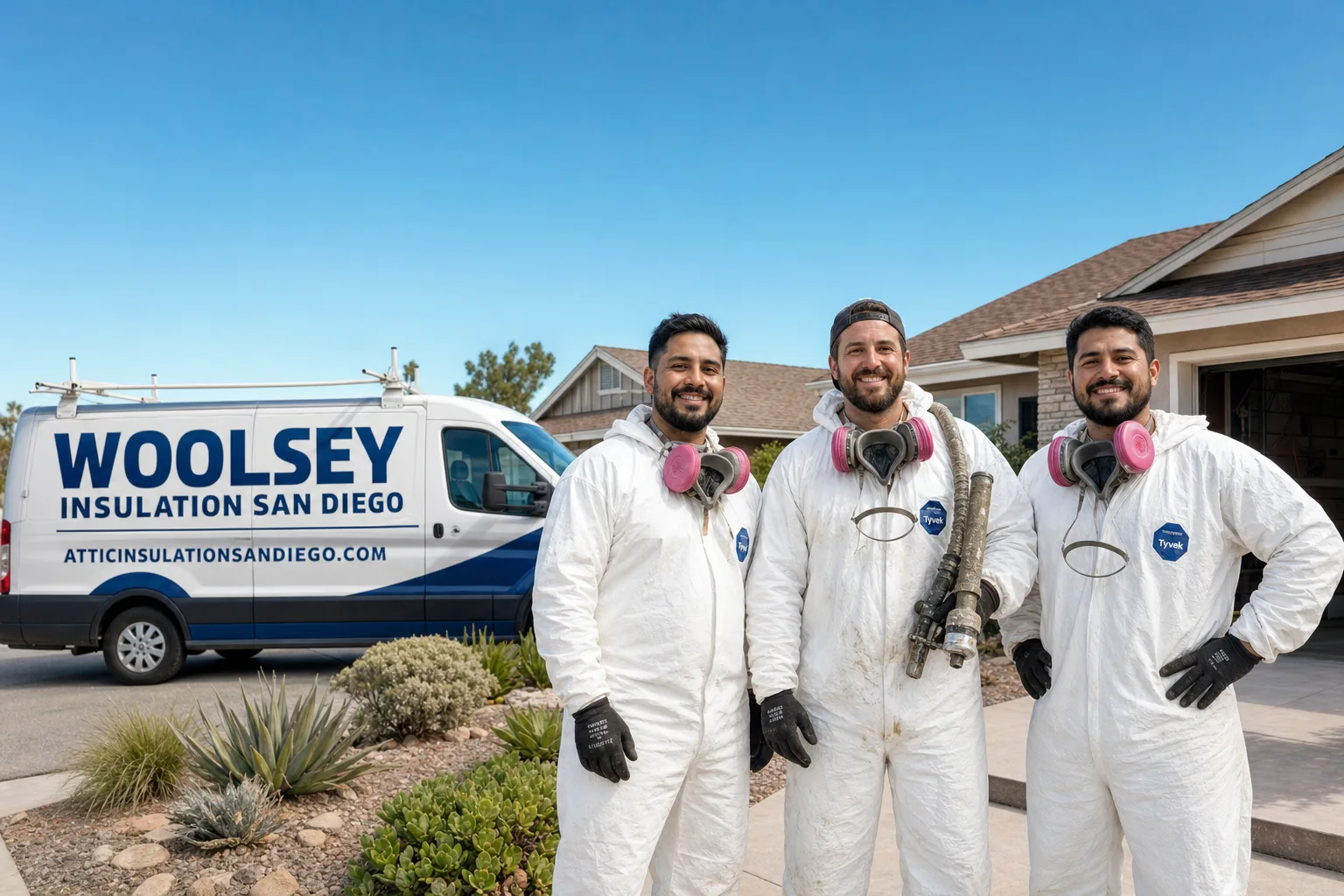
Woolsey Insulation San Diego is part of the Kingswell family of independently owned and operated insulation companies, founded in 2002. That’s not an accident of branding: we’re run locally, with local crews and local accountability. Glenn Hartley leads our team, and he’s built the operation around a simple principle that the industry keeps forgetting: a homeowner deserves to know what a job costs before it starts, and deserves to have the work fixed if it fails.
That’s The Kingswell Way. Say the price. Show up in the window. Leave the job site cleaner than you found it. Put the guarantee in writing. Come back if it fails, 365 days, no charge.
Wool was the first insulation. Woolsey keeps the idea in the name.
FAQs – Wall Insulation Cost in San Diego
How much does wall insulation cost per square foot in San Diego?
Wall insulation in San Diego costs $1.50 to $4.50 per square foot for blown-in materials and $2.50 to $7.00 per square foot for spray foam, including labor and materials. For a 1,200-square-foot wall area, that works out to $1,800 to $5,400 for most homes. Call (619) 344-8538 for an exact written quote for your specific wall area; estimates are free.
Is it cheaper to insulate walls or the attic?
Attic insulation generally costs less per square foot, at $1.00 to $2.50 per square foot for blown-in fiberglass or cellulose, compared to $1.50 to $4.50 per square foot for walls, because walls require drilling and patching access holes. Attic work also delivers faster return in San Diego’s sun-heavy climate. That said, if your attic is done and your walls are empty, walls are the next best dollar spent. Call (619) 344-8538 and we’ll walk through your home’s situation honestly.
Can you insulate walls without removing drywall?
Yes. Drill-and-fill insulation is the standard approach for existing homes in San Diego. Technicians drill small access holes through the drywall or stucco at each stud bay, fill the cavity with blown-in insulation under pressure, and then patch the holes. The process adds $1.00 to $2.00 per square foot compared to insulating open walls, but it avoids the demolition cost of tearing out and re-hanging drywall.
How much does spray foam wall insulation cost in San Diego?
Open-cell spray foam wall insulation in San Diego runs $2.50 to $4.50 per square foot, while closed-cell foam runs $4.00 to $7.00 per square foot, including labor and materials. For a typical 1,200-square-foot wall area, that’s $3,000 to $5,400 for open-cell and $4,800 to $8,400 for closed-cell. That’s the priciest wall insulation we install, but it’s also the most effective air and moisture barrier option for coastal homes. Call (619) 344-8538 for a written quote with exact numbers for your walls.
Does wall insulation add resale value to a San Diego home?
Wall insulation typically adds between $2,000 and $5,000 in perceived value to a San Diego home at resale, depending on the home’s age and the materials used. More importantly, it adds immediate comfort and energy savings while you live there. San Diego buyers don’t pay a premium for insulation the way they do a kitchen remodel, but an uninsulated older home will be a negotiating point. Conversely, a home with documented, professionally installed wall insulation is one less thing for a buyer to worry about.
Get Your Written Wall Insulation Quote
The best way to know what your wall insulation will cost is to get the actual number for your actual home. That’s what we give you: a free, written estimate from Woolsey Insulation San Diego with the full Kingswell Guarantee behind it. A live person answers the phone 24/7 at (619) 344-8538, and we’ll schedule a visit, measure your walls, and hand you a written price before any work starts. No door-step surprises, no price changes, no voicemail maze.
Pricing reflects the San Diego market as of 2026. Woolsey Insulation San Diego offers free estimates – call (619) 344-8538.
Written by Glenn Hartley, Owner at Woolsey Insulation San Diego, serving San Diego since 2002.
What Our Customers Say
"The guy didn't try to sell me on foaming the whole house. He said the attic was where I'd actually feel it and left it at that. Honest, and he was right, our bills dropped."
- Angela Ruiz"Our old insulation was flattened and basically useless. They removed it, cleaned up, and blew in new. Furnace isn't running constantly anymore and the first bill already showed it."
- Carl Yeung"Upstairs was always ten degrees hotter than downstairs in summer. They added attic insulation and the difference is night and day. Written price up front, no add ons at the end."
- Edith Marlowe