
How Much Does Radiant Barrier Installation Cost in San Diego?
Radiant barrier installation in San Diego typically costs between $1,200 and $3,800 for an average 1,500 to 2,500 square foot home, with most homeowners paying around $2,400. The price per square foot runs $0.80 to $2.50 for materials and labor combined, depending on whether the barrier is stapled to rafters, laid over existing attic insulation, or paired with new blown-in insulation. In San Diego’s climate, where summer attic temperatures routinely hit 140 to 160 degrees Fahrenheit, a properly installed radiant barrier can cut attic heat gain by up to 20 to 30 degrees and reduce second-floor cooling costs by 5 to 10 percent each summer.
Radiant Barrier Installation Cost Breakdown (2026)
The table below reflects what we’re seeing across San Diego County in 2026, from Chula Vista to Poway to Carlsbad. Prices vary by attic size, access difficulty, and whether you’re adding a radiant barrier to existing insulation or including it as part of a larger attic project.
| Project Scope | Typical Price Range (San Diego) |
|---|---|
| Stapled radiant barrier to rafters (1,000 sq ft attic) | $1,200 – $1,800 |
| Stapled radiant barrier to rafters (2,000 sq ft attic) | $1,800 – $2,900 |
| Radiant barrier laid over existing attic insulation (1,500 sq ft) | $800 – $1,400 |
| Radiant barrier + blown-in fiberglass upgrade (1,500 sq ft) | $2,500 – $3,800 |
| Radiant barrier + spray foam on attic floor (small attic, 600-800 sq ft) | $2,200 – $3,500 |
| Radiant barrier painted directly onto roof decking (radiant barrier paint, 1,000 sq ft) | $700 – $1,100 |
Those numbers cover labor, materials, and basic attic prep. What moves the price up or down in San Diego specifically?
First, attic accessibility. Homes in Clairemont Mesa and older parts of La Mesa often have tight attic hatches, low-pitch roofs, and limited headroom. That slows a crew down. Newer builds in Otay Ranch or 4S Ranch tend to have walkable attics with truss systems that make stapling straightforward. Expect to pay 10 to 20 percent more when the tech is working on their knees the whole time.
Second, existing insulation condition. If the attic floor has old, compressed fiberglass or rodent-damaged batting, laying a radiant barrier over it is a shortcut that won’t perform. That means removal or topping with fresh blown-in insulation, which adds $900 to $1,600 depending on square footage and R-value target.
Third, roof type. Radiant barriers perform best under shingle roofs with standard decking. Tile roofs, common across San Diego’s Spanish-style homes in South Park and Kensington, require slightly different fastening approaches and sometimes a hybrid installation method. That’s not a huge cost driver – usually 5 to 8 percent – but it’s real.
What Affects Radiant Barrier Installation Pricing in San Diego
Beyond the basics, these are the factors we see moving quotes week to week across the county:
- Attic square footage. Price scales almost linearly with square footage. A 900 square foot condo attic in downtown San Diego runs at the lower end. A 3,000 square foot attic in Scripps Ranch or Rancho Bernardo pushes toward the top of the range.
- Installation method. Stapling a single-layer or double-layer reflective barrier to the underside of roof rafters is the most common approach and costs more in labor than laying the material flat. Flat layment – barrier sheets draped over the top of existing insulation – is faster and cheaper but slightly less effective at blocking radiant heat gain in summer and has no meaningful effect in winter.
- Existing attic condition. Old insulation, sagging batts, moisture staining from a past roof leak, or rodent activity all require remediation before or during radiant barrier installation. In coastal zones like Point Loma and Pacific Beach, we sometimes find surface rust on metal fasteners and light mold on sheathing due to persistent marine layer humidity. That has to be addressed before a barrier goes up.
- Access and job site friction. Attics with pull-down stairs and standing room are fast jobs. Scuttle-hole attics, HVAC ductwork blocking rafter bays, and recessed can lights that need clearance baffles all add labor time. Expect a moderate premium for complicated attics.
- Combining with other attic work. Many San Diego homeowners pair a radiant barrier with air sealing or upgraded blown-in insulation at the same time. The barrier itself isn’t bundled – we give you a written line item for each component – but doing both in one visit is cheaper in total than scheduling them separately because the attic access, setup, and cleanup happen once.
- Material grade. Not all radiant barriers are the same. Double-sided foil, single-sided foil-faced kraft, and foil-faced polypropylene differ in durability, emissivity, and ease of installation. At Woolsey, we install radiant barrier products from brands we already trust for other insulation work, including Owens Corning and Johns Manville, so the material matches the home rather than whatever’s on the truck.
Is Radiant Barrier Worth It in San Diego Specifically?
San Diego is one of the few markets in the country where radiant barriers make clear, calculable sense for many homes. Here’s why.
San Diego’s inland valleys – think El Cajon, Santee, Escondido, and the I-15 corridor – see sustained summer highs above 85 degrees with intense, direct sun. Attic temperatures in those areas regularly reach 150 degrees by mid-afternoon. A radiant barrier reflects most of that radiant heat back out through the roof before it can soak into the attic floor insulation and, eventually, your ceiling. The effect is immediate and measurable with an infrared thermometer: attic air temps drop 20 to 30 degrees on a hot afternoon.
Coastal neighborhoods like La Jolla, Del Mar, and Encinitas benefit less in degree terms, but those homes often lack air conditioning entirely. When the marine layer burns off midday and the sun hits a dark asphalt shingle roof, a radiant barrier can mean the difference between a tolerable afternoon and an 85-degree second floor. For coastal homeowners, the value isn’t lower energy bills as much as it is comfort without mechanical cooling.
On the utility bill side, SDG&E’s current rates and time-of-use pricing make afternoon cooling the most expensive electricity you buy all day. The less heat your attic pumps into your living space between 4 and 9 p.m., the less your AC or whole-house fan has to fight. Most of our San Diego customers report a 5 to 10 percent cooling-season reduction after a radiant barrier install, with the biggest savings on homes with ducted HVAC in the attic.
Radiant Barrier vs. Traditional Attic Insulation: What’s the Difference?
Different tools for different jobs. Traditional insulation – fiberglass batts, blown-in fiberglass, blown-in cellulose, or spray foam – slows conductive heat transfer through the attic floor. It’s rated in R-value and works year-round, in both summer and winter.
A radiant barrier doesn’t have an R-value. It works by reflecting radiant heat – the heat that travels in infrared waves from the hot roof deck down into the attic. It’s a summer-focused solution. That’s why in San Diego, we often recommend the two together: a radiant barrier at the rafter line to keep heat from entering the attic in the first place, plus adequate insulation at the attic floor to handle whatever heat remains.
If your attic has less than R-30 of existing insulation, upgrading insulation will usually deliver more total annual savings than a radiant barrier alone. But for homeowners whose insulation is already adequate and who still feel the upstairs bake in August, the radiant barrier is the right next step.
How the Radiant Barrier Installation Process Works
Here’s a straight walkthrough of how a typical radiant barrier installation in San Diego goes, from first call to finished attic.
Step 1: The Estimate
You call us, a real person answers – no voicemail tree, at any hour, 24/7. We ask a few questions: approximate square footage, attic access type, whether you already have insulation and roughly how old it is. Then we schedule a visit. The estimate is free. Before any work starts, you get a written price. Every time. No door-step changes, no “oh, the crew discovered” adjustments later. That’s the Kingswell way: say the price, show up, do the work, leave it clean, put the guarantee in writing.
Step 2: The Install
On install day, we arrive in the promised window. Background-checked, uniformed technicians. They’ll cover entry paths, protect the flooring, and set up in the attic. The work itself usually takes half a day to a full day for a standard residential attic. The radiant barrier is cut on site to fit each rafter bay, stapled cleanly, and trimmed around electrical boxes, venting, and ductwork. If you’re pairing it with blown-in insulation, that happens at the attic floor in the same visit.
Step 3: The Walkthrough and the Paperwork
When the crew finishes, they’ll show you what was done – photos, if you want, since not everyone wants to climb a ladder. You’ll get the written guarantee before we leave. That guarantee covers the installation for 365 days. If something isn’t right, we come back and fix it at no charge. In writing.
How to Save on Radiant Barrier Installation
Sensible ways to keep your total bill down without cutting corners on materials or labor:
- Get the exact number before work starts. A written price means you know what you’re paying. No surprises. That’s not a discount – it’s protection against the alternative. You can reach us at (619) 344-8538 for a free estimate.
- Bundle it with other attic work. Adding a radiant barrier during an insulation upgrade or air sealing job costs less together than scheduling two separate visits. Setup, cleanup, and access happen once.
- Layer a radiant barrier over existing insulation instead of stapling. For attics where the insulation at the floor is already in good shape, laying a barrier flat over it is faster and cheaper than rafter stapling. It’s slightly less effective at reflecting heat, but for many San Diego homes the simpler install is the right trade.
- Ask about material options. Single-sided foil products cost less than double-sided. If you’re installing in a standard shingle-roof attic without unusual moisture exposure, single-sided gets the job done for less.
- Schedule during the shoulder months. Radiant barrier demand spikes in May, June, and July when San Diegans start feeling the heat. Booking in fall, winter, or early spring won’t usually change the price we quote – we don’t run seasonal pricing – but it does mean better scheduling flexibility.
Radiant Barrier Installation Cost by San Diego Neighborhood
Your neighborhood affects the practical cost of the job in ways worth knowing about.
- Inland East County (El Cajon, La Mesa, Santee, Lakeside): Older single-story ranch homes with moderate-sized attics and decent access. Most jobs land between $1,400 and $2,400.
- North County Inland (Escondido, San Marcos, Vista, Poway): Mixed housing stock – some 1970s tract homes, some newer builds. Typical range $1,500 to $2,800 depending on attic complexity.
- Coastal (Carlsbad, Encinitas, La Jolla, Point Loma): Attics in these areas are often smaller and more awkward. Higher proportion of tile roofs. Expect $1,600 to $3,000 for most homes.
- South Bay (Chula Vista, National City, Imperial Beach): Similar to East County in terms of age and access. $1,300 to $2,500 covers most homes.
- Central San Diego (Mission Valley, North Park, Clairemont, Kearny Mesa): Wide variation in housing stock. Condo attics at the low end, larger single-family homes toward the top. $1,200 to $2,900.
FAQs – Radiant Barrier Installation Cost
How much does radiant barrier installation cost per square foot in San Diego?
In San Diego, radiant barrier installation typically runs $0.80 to $2.50 per square foot of attic space, including labor and materials. Stapled rafter installation sits at the higher end, while barrier laid over existing insulation lands at the lower end. Give us a call at (619) 344-8538 and we’ll give you a written quote for your exact attic, at no charge.
Does a radiant barrier actually save money on energy bills in San Diego?
Yes, modestly. A radiant barrier in a San Diego attic typically cuts summer cooling costs by 5 to 10 percent, depending on the home, the attic’s current insulation, and whether the HVAC ducts run through the attic. The biggest dollar savings go to homes in inland areas like El Cajon and Santee with attic-mounted air handlers and afternoon peak-rate cooling from SDG&E. The effect is smaller in coastal zones where AC use is lighter to begin with.
Is radiant barrier installation worth the cost in a coastal climate like San Diego’s?
For inland San Diego homeowners, yes, in most cases. Attics in El Cajon, Poway, and Escondido routinely reach 150 degrees in summer, and a radiant barrier drops that meaningfully. For coastal homes without air conditioning, a radiant barrier can improve upstairs comfort on hot afternoons even if the dollar savings on utilities are modest. Homes that are already well-insulated see less relative improvement from adding a barrier alone.
Can I install a radiant barrier myself to save money?
You can, but we don’t recommend it. Attic work in San Diego attics means working in 130-plus-degree heat, breathing fiberglass dust, balancing on joists, and maneuvering around live electrical wiring. That’s a real safety risk. A professional install also gets you a clean fit around vents and recessed lights, which matters for both performance and fire safety. Radiant barrier labor in San Diego is a relatively small part of the total bill; for most homeowners the safety tradeoff isn’t worth the savings.
How long does radiant barrier installation take?
Most residential radiant barrier installations in San Diego take 4 to 8 hours – a standard single-day job for a two-person crew. Larger attics or installs paired with blown-in insulation can run into a second day. We’ll tell you the expected timeline in writing before the crew arrives, as part of the standard Kingswell commitment to a real arrival window.
Is it cheaper to repair or replace an existing radiant barrier?
If the barrier is less than 10 years old and damage is limited to a few sagging or torn sections, spot repair is cheaper – typically $250 to $500 depending on the extent. If the material is older or has widespread tearing, moisture staining, or rodent damage, replacement usually makes more sense than chasing repairs. We’ll show you the condition during the estimate and give you a written price for either option.
Why San Diego Homeowners Choose Woolsey Attic Insulation for Radiant Barrier Work
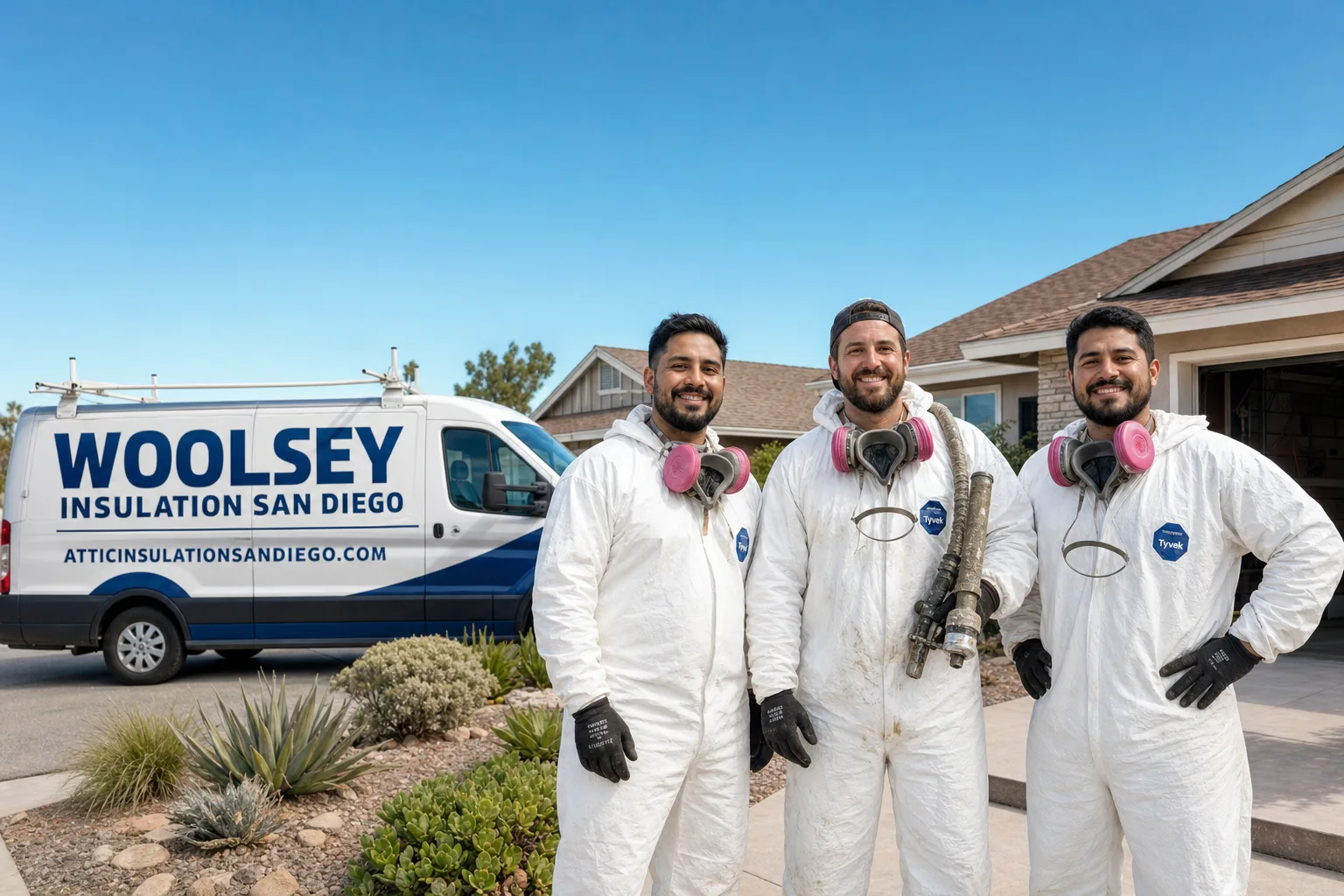
Woolsey Attic Insulation is part of the Kingswell family of independently owned and operated insulation companies, founded in 2002. We’ve been installing attic insulation and spray foam across San Diego County since the beginning, and radiant barrier work fits squarely within what we do – unlike a general contractor who dabbles in attics, this is the whole job.
Every Woolsey job runs the same way, and it’s written down: a written price before any work starts, a committed arrival window, a clean job site, a written guarantee on the work, and a free return visit if anything fails within the guarantee period. We call it the Kingswell Guarantee. It applies to radiant barrier installation exactly as it applies to blown-in fiberglass, spray foam, or air sealing.
We work with eight insulation and radiant barrier brands – Owens Corning, Johns Manville, Knauf, Rockwool, CertainTeed, Icynene, Demilec, and GreenFiber – so the product recommendation fits your San Diego attic, your home’s architecture, and your budget. Wool was the first insulation. Woolsey keeps the idea in the name.
Our owner Glenn Hartley has spent his career in attics across the county, from Chula Vista to Oceanside. He trains every technician on the same standard: if you wouldn’t put it in your own attic, don’t put it in the customer’s. That’s the whole philosophy.
Get a Written Radiant Barrier Installation Quote in San Diego
Radiant barrier installation in San Diego, done right, should be a straightforward job: a clear price, a clean install, and a written guarantee that means something. That’s exactly what you get when you call Woolsey Insulation San Diego at (619) 344-8538. A live person answers, day or night. We’ll talk through your attic, schedule a free estimate, and put the number in writing before any work starts. No pressure, no door-step surprises, no fine print you didn’t read.
If you already know you want a radiant barrier – or you’re weighing it against a full insulation upgrade – call (619) 344-8538. We’ll help you sort out what makes sense for your home and your budget, in plain English, with real numbers.
Pricing reflects the San Diego market as of 2026. Woolsey Insulation San Diego offers free estimates – call (619) 344-8538.
What Our Customers Say
"Good work and a fair price on spray foam in the garage. The crew did track a bit of the old insulation through the garage, but they vacuumed it up before they left. Garage is way warmer now."
- Brenda Falk"Drafty old house that never felt comfortable. After the attic and some air sealing it's a different place. On time, clean, and the quote didn't change. Wish I'd done it years ago."
- Dmitri Kozlov"Showed up on time, laid down protection on the floors, and were careful going into the attic. Explained exactly what they were doing and why. House holds its heat so much better now."
- Preston Hale